The All-Purpose Nuclear Bedtime Story Call-In
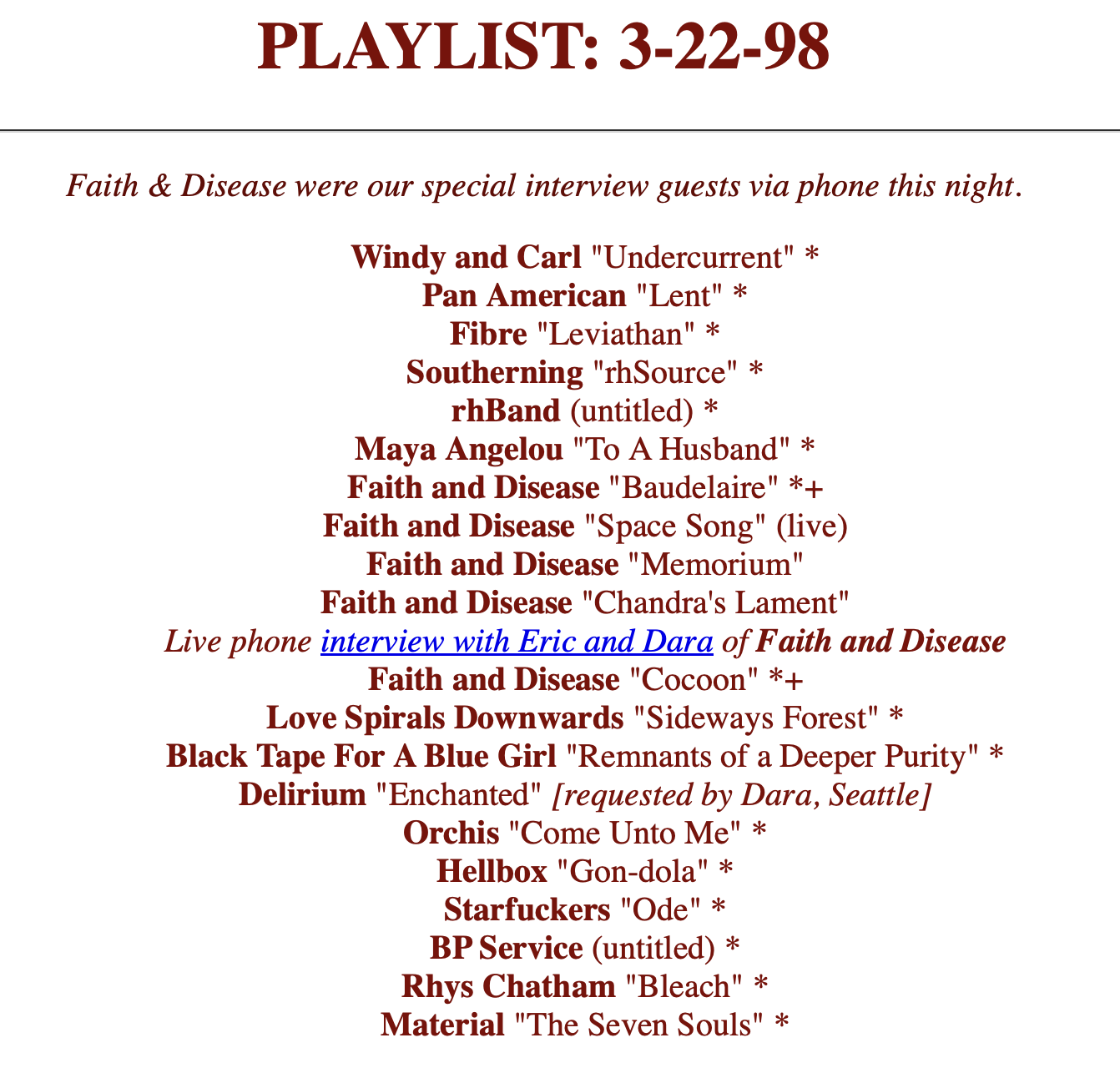
Faith & Disease are an ethereal band that hail from the city best known for breeding the “grunge” scene… Seattle, Washington. While having very little, if anything, in common with that brand of rock, neither do they really fit in with the Gothic scene. With their fourth full-length album, “Insularia,” the band have solidified and perfected their beautifully melodious style of ethereal pop rock. Fans of “slow core” (i.e.. the band Low) should take note, as well as fans of 4AD and Projekt Records. Gorgeous female vocals, lush electric and acoustic guitar, moody keyboard, exotic percussion and the occasional flute or violin are what comprise the instrumentation for songs written by Eric Cooley and Dara Rosenwater, assisted by Steven Knouse and Joshua Furman — along with a host of special guest musicians, including Chris and Carla of the Walkabouts. Though Faith & Disease have been an active force in their hometown, and within the American Goth scene for some time, they are just now broadening their fan base through college radio airplay. The band tour regularly, which may be considered a rarity among dark-tinged acts. Justin and I were lucky enough to catch them live at a show in Portland, Oregon, and were quite impressed by their performance. This interview, however, was conducted live over the air, via telephone.
Justin: Wow! Your voices sound remarkably like they do on that station ID we recorded with you.
Eric: Well, we’re the same people that did that!
Justin: You’re kidding!?
Eric: My voice hasn’t matured that much in three months.
Justin: You’re not in a men’s room right now, are you? (Referring to the station ID recorded in the Men’s Room of Satyricon in Portland, Oregon.)
Dara: No. No, we’re actually at headquarters, at Ivy Records.
Eric: We’re at the Ivy Compound, in Seattle.
Justin: The Ivy Tower?
Eric: Actually, it’s pretty close to that; we’re on the Tenth Floor of the Ivy Office, and there’s only 10 floors here, so it’s a little tower.
Anji: Wow, you’re in the Penthouse Suite.
Dara: From here you can see the — which harbor is it? I don’t know, but it’s an amazing view!
Eric: Yeah, it’s a big body of water.
Anji: Ooh, ahh — waterfront property.
Eric: And we can see David Gobel, who funds Ivy Records, in the other room — and it is kind of a penthouse, because he has a robe on and a couple of women in bikinis next to him.
Anji: In-door Jacuzzi?
Dara: He’s in the room with the gold door. Ha ha ha.
Eric: No, actually he has a white Microsoft tee-shirt and sweat pants on.
Anji: We’re both wearing green T-shirts.
Eric: I’m actually wearing a green shirt, too.
Dara: I’m not. I’m wearing black (distraught).
Anji: Oh, you’re not in the club! The Spring Equinox Club.
Eric: I feel so… assimilated.
Anji: So, what’s new for you guys?
Dara: Well, we just put out Insularia. It’s our fourth album and it’s been doing really well. Really, really well. We’re getting ready to go on a US. Tour in June. Once all the annoying side work is done, we can hit the road.
Justin: So when are you going to be in Southern California?
Dara: Soon…
Eric: We’re going out for about a month or so. We live in Seattle, and we’re going to go from the East Coast and back. We’re definitely going to hit Southern California because we always do well there. We’ll have at least five stops in Southern California.
Anji: So have you guys toured the US before?
Dara: Not extensively. We’ve pretty much stuck to California, Oregon — we took a trip down to Utah a couple of years ago and that was pretty fun, considering we were all sardined into a ’69 bus that was leaking the whole way. It was an experience.
Eric: We played 11 dates in, like, 14 days. It was the Fortune Our Sleep tour. We really went all over the US. We didn’t go into the Mid West or to the East Coast, but we did the whole West Coast.
Anji: So are you guys getting radio air play with your new record?
Eric: We are. Last week charted with eleven stations and the album has only been out for a week, and we got a great review in CMJ Weekly. We have this company that does radio for Ivy Records, and they sent out CDs to 300 radio stations. So, I hope we’ll do well. It’s not the kind of music that’s immediately going to catch on, ‘cause it’s not like Beck or Foo Fighters or May Lou Lord, or whatever, but…
Anji: It’s beautiful. I really love this album; it’s definitely my favorite.
Dara: Oh, mine, too.
Anji: Such good song writing. And it has a lovely cover, too.
Justin: Where did you get the picture on the cover?
Eric: It’s a really old photograph from 1855 that I got out of a book of erotica. It’s public domain; there’s no copyright on it. Still, it’s altered quite a bit. The photographer is anonymous, as well as the subject. I thought the image of the woman staring into the mirror seemed to kind of reflect the body of the material. And Insularia is two words that we strung together. We thought we were making up a word. We used the word “insular” –which is kind of keeping to yourself and withdrawn, and “aria” — which is the ancient form of music. Thus, Insularia. But we actually found out, via the Internet, of all places, that insularia is Latin for island. But that’s OK, too. It’s like an island of music.
Anji: Speaking of the Internet, you guys probably have a web site and e-mail address, right?
Eric: Yeah we do. If people out there want to listen to tracks from the new album, actually from all four of our albums, they can go to ivyrecords.com. And they can even order it from there. People always ask me, from other areas, where they can get our CDs, although this one is being distributed really well, so it should be available at practically any record store across the U.S. We have about thirty distributors, so it shouldn’t be a problem, but if people want to order it really quickly, they can also call up CD-LASER, which is a VISA/Mastercard phone ordering system.
Justin: I remember some Projekt Records releases being available through that.
Eric: They’re a great service. Even if you don’t want to find Faith and Disease, they have a lot of independent artists who are lumped together into this genre of dark alternative music, or whatever. They have basically every title imaginable in that field, so, it’s 1-800-CD-LASER, if you’re wondering.
Anji: Someone probably is, out there somewhere, silently, not wanting to call in and ask.
Eric: “And if you’re just tuning in, you’re listening to…” (mimicking a radio personality)
Justin: We can say that every two or three minutes.
Eric: Well, sometimes I’ll be tuning into a radio station and there’ll be a band interview, but they won’t say who they are, so you can’t even tell who’s talking or what band it is.
Anji: Yeah. Someone called up during our Love Spirals Downwards interview last week and asked if we played music. I think they got the idea that we just talked because we were talking to Ryan for a half hour non-stop.
Dara: Which is easy to do, but…
Eric: Yeah, as my phone bills can attest to!
Anji: Ah yes, we do have to worry about your phone bill! What else should we ask you, before you go? We probably shouldn’t talk for too much longer.
Eric: Yeah, we’re probably boring all your listeners.
Dara: No, they’re all fast asleep.
Eric: They’re going, “Why don’t you guys play some music?”
Justin: You know, when we talked to Ryan from Love Spirals Downwards, two weeks ago, all he talked about was setting himself on fire and stripping on stage and whatnot.
Eric: Oh, he’s such a wild man.
Dara: Yeah — Go Ryan!
Anji: He went crazy when they performed (at the Projekt Festival) let me tell ya!
Justin: Actually, I don’t think he stood up the whole time! He was glued to the chair with his acoustic guitar.
Dara: Yeah, he was like that when we played with them at the Troubadour — when was that? A year or two ago?
Eric: We’ve played with them a couple times. Their second live show ever was with us in Seattle. It was weird, ‘cause I thought they were really established — well, they were, but they hadn’t really played live up ‘’til that point. They’d done one show in California and then they played with us. They’ve played quite a bit since then, of course. But it was cool to play with them that time. They stayed up at our house. And then when we played the Troubadour with them, we stayed at their apartment. I really like what they’re doing.
Anji: It’s good when bands befriend each other and stick together.
Eric: Yeah, it definitely can work.
Justin: Especially with bands who are as genre-less as you two. I mean, you don’t fit easily into any specific genre, and so, it’s cool when you have a similar vein running through your music to hook up and do shows together and stuff.
Anji: Yeah, you don’t consider yourselves to be Gothic, do you?
Dara: No. No.
Anji: I didn’t think so.
Dara: I mean, we appeal to many different people.
Eric: We definitely have roots in that scene.
Dara: But being stuck in that stereotype is not too fun. We just hope that, I don’t know, people have been very responsive and I just hope that continues.
Anji: I was just thinking about how Ryan said he didn’t really like playing live and wondering how you feel about the experience of playing live as opposed to the studio experience.
Eric: Well, we’re based in Seattle, which has a lot of live music venues, a lot to offer. In order to survive… It just seems like it’s such a natural thing here for a band to form and play live because it keeps you, between doing albums and touring, really focused. We’ve always been a band that plays live a lot, beginning with the first album. We’ve played probably 100 live shows by now. So we like playing live. It’s fun. You meet people who come up and talk to you afterwards. Oh! I have to tell you, this so weird! We have the radio on behind us, a Seattle station, and one of our songs just came on!
Anji: You’re getting simultaneous radio broadcasting!
Eric: Yeah, we’re such big rock stars. No, we’re not at all, really.
Be sure to check out their website ivyrecords.com for current information!
— Interview transcrption and intro authoring by Anji