
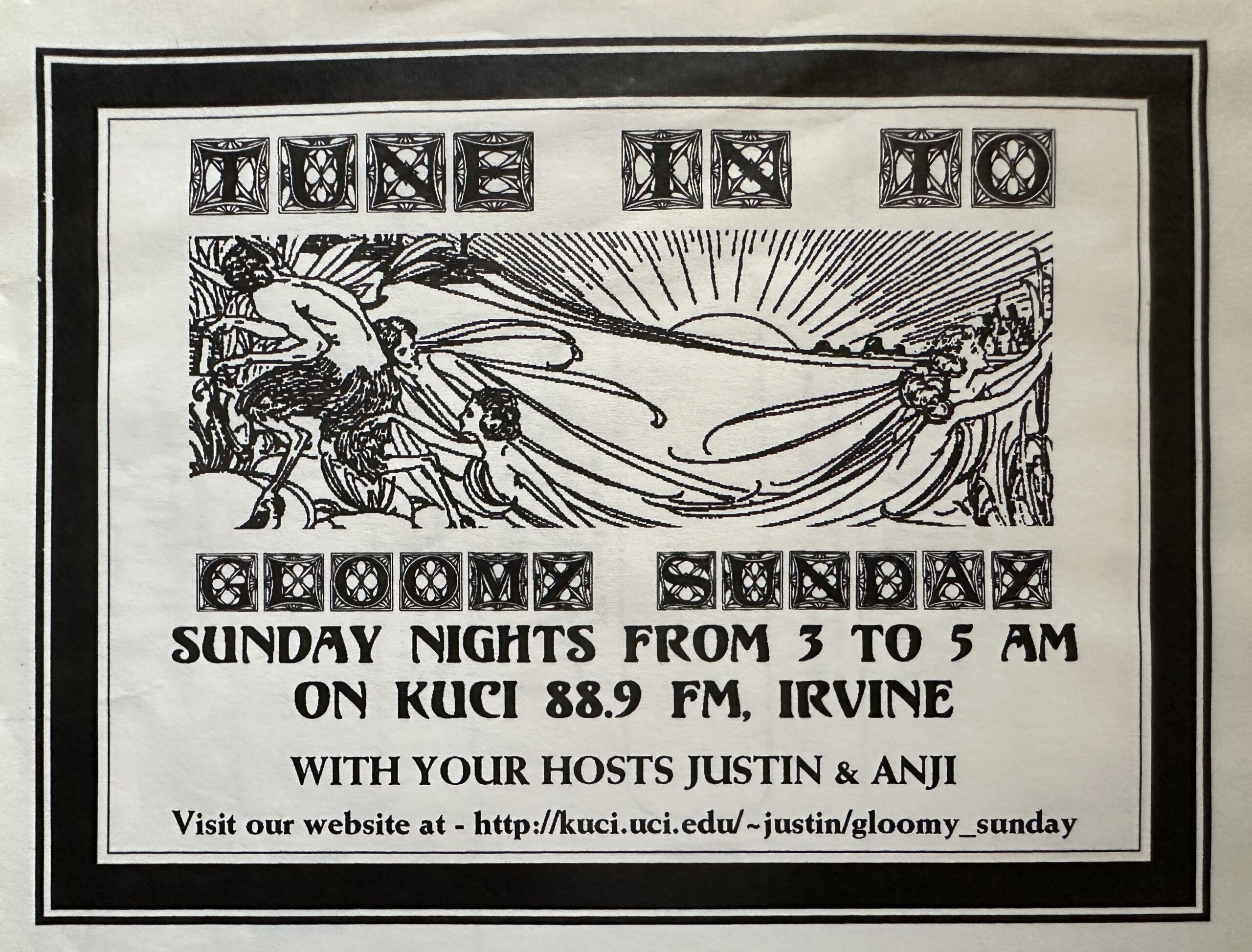
Having spent years documenting the underground through the tactile, ink-stained medium of fanzines, Anji’s move to college radio represented a fundamental shift in how she shared her passion for music, literature, and cinema. That transition from the printed page to the living, breathing medium of the airwaves began when KUCI 88.9 FM DJ Däch invited Ravensong to appear on his show, Closed Caskets for the Living Impaired, in 1996. During their conversation that night, Anji enquired as to how one becomes a DJ at the college station. Learning that anyone could apply to the program, she and her partner Justin jumped at the chance.
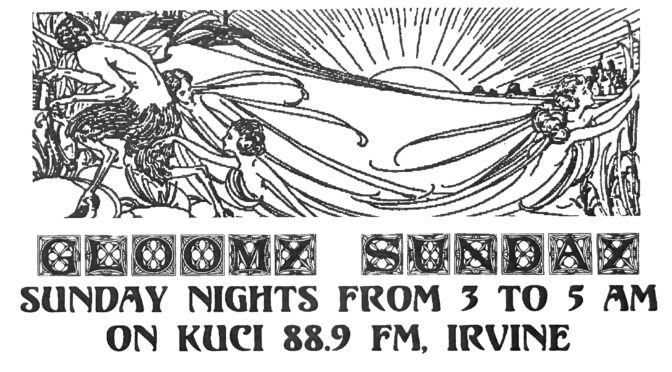
The concept for Gloomy Sunday was born from a desire to unite the duo’s varied musical tastes under a shared, shadowed aesthetic. When a 3:00 to 5:00 a.m. Sunday morning slot opened up at KUCI, the timing proved serendipitous: Gloomy Sunday had found a home that suited both its name and its atmosphere. They inhabited this late night/early morning slot for a full semester, using two versions of the infamous song as musical signatures: Diamanda Galás’s interpretation opened the show, while Billie Holiday’s introduced the second hour.
Establishing the Niche: The Genesis of a Sound
Gloomy Sunday established its identity from the very first broadcast on October 20, 1996. The inaugural playlist—titled “Our First Show Ever!” on the show’s website—carved out a distinct atmospheric niche within KUCI’s programming.
By opening with Projekt’s Lycia and moving through the ethereal textures of 4AD’s This Mortal Coil, Dead Can Dance, and His Name Is Alive, as well as moody cuts by Cranes and Skinner Box, the duo signaled a departure from standard radio fare. The debut set favored mood and eclecticism over mainstream familiarity, blending the haunting dream-pop of mid-90s artists with vintage jazz and blues by Bessie Smith and George E. Lee, the alternative 70s rock of Velvet Underground and Big Star, and the folk leanings of Sol Invictus and Current 93. Melodic indie pop selections by Tattle Tale and Nerdy Girl, along with an untitled track from an ESP Summer cassette, added a more intimate dimension to the mix.Local bands including Babyland, Geko, E. Coli, and the duo’s own band, Datura, brought the selection closer to home.
As Anji wrote on the KUCI show page after its run concluded, “Consistency of mood is what Gloomy Sunday strove for with its format,” noting that while the music played was “more-or-less gloomy in one way or another, many different genres of music were represented.” Within KUCI’s “Free Form” format, the duo brought together ethereal and darkwave sounds, ambient and experimental music, vintage blues and big band recordings, alongside poetry and spoken word.
This inaugural broadcast established a consistent mood paired with unexpected selections that bridged the gap between melancholic beauty and industrial weight.
The Lynchian Aesthetic: A Cinematic Lens
One defining characteristic of the show was its immersion in the surreal, dreamlike landscapes of David Lynch. This was not merely an interest in soundtracks, but a sophisticated curation of a specific cinematic atmosphere. The show itself functioned as a bridge between jazz, dream-pop, and noir surrealism. This intersection was perfectly captured by tracks like “Up in Flames” by Julee Cruise and Angelo Badalamenti from Industrial Symphony No. 1: The Dream of the Brokenhearted, as well as “Sycamore Trees” from Twin Peaks: Fire Walk with Me—a collaboration between Badalamenti, Lynch, and jazz vocalist Jimmie Scott.
The Twin Peaks connection continued with Julee Cruise’s “She Would Die for Love” and “The Voice of Love,” which are vocal adaptations of instrumentals from the show’s soundtrack, featuring lyrics by Lynch and music by Badalamenti. To deepen the immersion into this universe, the duo additionally incorporated the eerie tapes of FBI Agent Dale Cooper (voiced by Kyle MacLachlan). Beyond Twin Peaks, they explored the unsettling textures of the Eraserhead soundtrack—including both the original recording of “In Heaven (The Radiator Lady Song)” and Miranda Sex Garden’s cover—as well as the noirish depths of Lost Highway, which notably featured This Mortal Coil’s “Song to the Siren.” The impact of Lynch’s world was evident on Gloomy Sunday.
A Collage of Textures: Poetry, Noise, and Noir
Beyond the cinematic, the show’s “Free Form” style allowed for a complex layering of disparate genres. Following in the footsteps of the duo’s work on the fanzine Descent, spoken word was woven directly into the programming rather than treated as a separate feature. The hosts frequently layered the provocative prose of William S. Burroughs and the sharp, modernist voices of Anne Sexton, Sylvia Plath, and Edna St. Vincent Millay over ambient recordings and quieter musical pieces to create immersive sound collages.
This literary depth was balanced by a restless exploration of sound. The duo frequently folded the melancholic elegance of vintage jazz and blues songs performed by Josephine Baker, Annette Hanshaw, Cab Calloway, Ruth Etting, and Billie Holiday —into sets dominated by modern industrial and dark pop textures. Some playlist sequences made these connections between past and present melancholy particularly explicit, such as following Marlene Dietrich’s “In den Kasernen” with Peter Murphy’s “Marlene Dietrich’s Favorite Poem,” or pairing Coil’s “At the Heart of It All” with Plath’s “Ariel.”
To maintain a sense of tension and prevent the show from settling into predictable rhythms, they utilized experimental ambient and noise, incorporating the unsettling textures of Throbbing Gristle and the avant-garde abstractions of Nurse With Wound. These elements, combined with the vintage jazz selections, broadened the show’s palette far beyond its contemporary underground roots. Ultimately, this unique blend gave Gloomy Sunday a reach across eras, allowing older expressions of longing, melancholy, and theatricality to converse with newer ones.
Community in Real Time
The show also served as a living ecosystem for the local underground. Unlike the slow-motion, delayed feedback of the printed zine page, the radio allowed for a community to evolve in real time. Gloomy Sunday frequently featured the projects the duo was actively building, including Ravensong, Datura, and their collaboration with Alan Wilkes, Ain Soph Aur. But the show was also a deeply personal affair, with Anji and Ryan frequently dedicating tracks to family and friends—such as playing Japan’s “Ghosts” for Anji’s mom, “Mary Loves the Warzone” for their namesake pal, or “Fine Friend” by Pale Saints from Anji to her co-host Justin.
This intimate atmosphere extended to a dedicated community of late-night listeners. Playlist annotations from the era reveal a surprisingly active audience, with callers from across Orange County requesting everything from the ethereal rock of This Ascension’s “Swan Dive” (for James in Fountain Valley) to the darkwave of Xymox’s “Promises” (for John in Huntington Beach) and even the demo version of Devo’s “Jocko Homo” (for Aron in Costa Mesa). These requests, alongside special broadcasts like Anji’s birthday episode –with several guests noted as visiting the studio– made the 3:00 am airwaves feel like a shared, late-night gathering rather than just a lonely broadcast.
The Digital Bridge: From Airwaves to the Web
As the show matured, the mastery of the airwaves was accompanied by a mastery of the digital frontier. Under the tutelage of local music writer and DJ Ned Raggett, the duo transitioned from radio enthusiasts to amateur coders, learning to navigate the burgeoning world of web development at a time when websites were built by hand using HTML and tables.
This technical literacy allowed them to leverage the station’s free webspace to launch their first digital footprints. The Gloomy Sunday website quickly became an extension of the show’s community. In an era before Google, when sites were shared largely by word of mouth, it served as a vital hub. The duo actively posted playlists for listeners and bands to check, maintained a massive links page for the underground scene, and hosted a guestbook where fans could leave comments. They even featured a “Gloomy Sunday Folklore” page, dedicated to the strange, sometimes dubious history of the infamous song that gave the show its name—inviting listeners to contribute their own pieces of the myth. They also created pages for Ravensong and Datura.
These early sites on the KUCI server represented the final stage of their early evolution: the movement from the printed page, through the broadcast mic, and finally into the digital space.
Evolution and Transition
The intense, sleep-deprived energy of the 3:00 AM to 5:00 AM slot eventually necessitated a shift. After a brief hiatus following their final Gloomy Sunday broadcast on Easter morning, 1997, the duo returned to the airwaves in July 1997. This new chapter, titled The All-Purpose Nuclear Bedtime Story, moved the broadcast to a more accessible Saturday night slot from 8:00 PM to 10:00 PM.
While the time slot changed, the spirit of experimentation remained. The foundational years at KUCI—defined by the intersection of underground music, DIY coding, and community connection—established the creative blueprint that would later inform Anji Bee’s global digital endeavors.