The Internet Archive has launched the IUMA Collection on their service. This is independent music culled from the website, whose full name is Independent Underground Music Archive. Two songs from my duo with Justin Johnsen are included, listed under the short-lived band name, Delphinium.
Here’s the band story, taken from our old mp3.com page:
Delphinium are Justin Johnsen and Anji Bee, who have made music, DJ’d radio shows and created fanzines together since the early 90’s.
Coming together as a recording project at Long Beach City College, Johnsen and Bee have gone through many changes to become Delphinium. Originally collaborating on Justin’s solo project, Ravensong (as well as Anji’s fanzine, “Substitution,”) their collaboration slowly morphed into the musical duet, Datura, with which they made a name for themselves in the underground industrial-goth scene of Long Beach and surrounding Orange County areas.
Always eager to explore new ideas, the two became DJs at the notoriously avante garde college radio station, KUCI 88.9 fm (in Irvine, California) where they were exposed to many new musical ideas and partnerships. Datura began to take a back seat to a plethora of smaller side projects of a more experimental nature, as well as their heavy involvement in the radio station itself over the following few years.
Now the duet has returned to complete and release their body of material, under the new name of Delphinium. Still searching for a label to release their first album, the band are offering a 9 song DAM cd through mp3.com with a combination of 24, 16, 8 and 4 track recordings. They also have a number of additional demo tracks which they plan to re-record digitally in the near future.
Well, obviously the re-recordings never happened, and we never hooked up with a label, either. But we have these two songs online as a record of my time previous to joining Love Spirals Downwards.
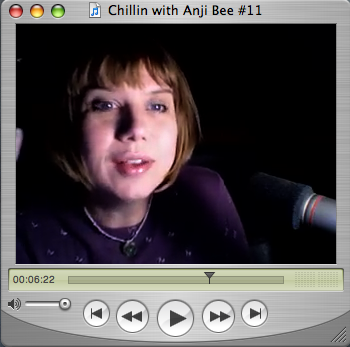
Another loopy episode reflecting on the kindness of fans, the tininess of the podosphere, and the evilness of cats on heaters. I also share a photo of one of the viewers; could it be you?
After answering Rik’s interview questions, I ended up slimming down my reply to his first question because it was so long. Thought I would go ahead and share it here, though, for anyone who is interested in learning more about my musical timeline.
You divide your time between a few projects, Lovespirals and Delphinium being the most visible. How does this affect the way you write?
Actually, it’s been a lot more complicated than that! Delphinium really began in the very early 90s as me collaborating with Ravensong (whom I still need to put up on Mp3.com…), until it morphed into a new project called Datura. Before Datura released anything (aside from a cassette demo), we found out another band was using the same name, so we hunted around for a new one, and came up with Delphinium. But before Delphinium really took off, Justin and I got sidetracked by another project with some friends of ours, called Ain Soph Aur. It was an improv experimental band that attempted to combine mystical traditions and music, and we got so caught up with it that Datura/Delphinium was totally forgotten!
After about a year with Ain Soph Aur, I started jamming with fellow KUCI DJ’s, doing various live and recorded improv sessions, until I ended up collaborating pretty heavily as a duet with home taper, Jake Anderson, called Celesteville. We were doing lo-fi pop stuff, with both of us switching between a ton of instruments; I played some guitar, accordion, sampler, all kinds of percussion and toys…. it was fun. I think I needed something light after that ASA experience, and I had needed both improv situations after the heavy studio time with Delphinium. I like a blend of programmed, carefully crafted music, and spontaneous performance, too much of either is a drag, musically. That’s what I learned from all that experimentation.
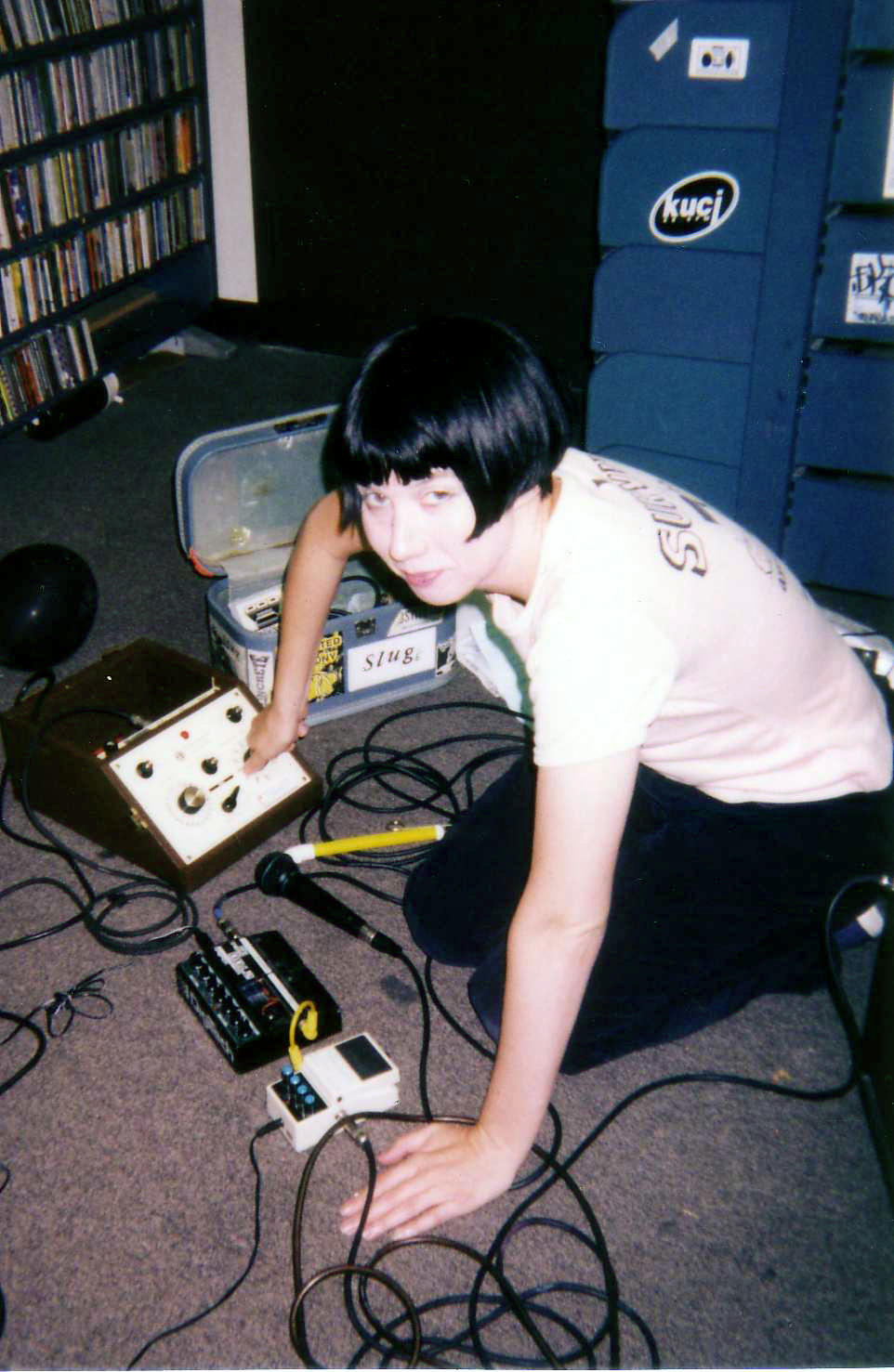
Anji Bee during a live on-air jam session at KUCI 88.9 FM in late 1998
Now, enter Ryan Lum! After all the insanity of live improv and 4-track cassette recording, I was pretty excited to be lucky enough to get involved with a professional recording outfit, such as Love Spirals. It can be terribly frustrating having your efforts practically thrown away for over a year, which is how I came to feel, looking back on my time with Ain Soph Aur and Celesteville. I was more than ready to settle down, write some real songs, perfect the vocals and just get really into the recording process. Unfortunately, Ryan has been overwhelmed by problems with his studio setup most of the time we’ve been together! His computer died twice, causing him to lose precious data, and he’s had a lot of problems getting his software to work correctly ever since. We haven’t actually gotten to do much work together yet, even though we’ve been together 2 years.
Meanwhile, I kept writing songs, either tucking the lyrics away in my diary, or recording the vocal melodies to cassette. Through the Internet, I started meeting various musicians, and collaborated with a few of them. I guess music is kinda like breathing for me, it’s something that I have to do in order to live, you know? I go nuts if I’m not working on something music related! It doesn’t always have to be singing, but I was so primed to work with Lovespirals last year, that I had to divert some of that energy somewhere or I was going to crack. So what happened is that I recorded with 3 different bands over 2000, all very different from one another. I did some Gothic-tinged electronica and darkwave with a band called Voiceless, experimental Drum ‘n’ Bass and Down Tempo with Aslan’s, and then some poppy Trip Hop and Drum ‘n’ Bass with Dreamzone 51. I was more or less doing all the projects simultaneously, just grooving off whatever music the different musicians would send me. Sometimes I’d use songs or poems that I had been saving for Lovespirals, but other times I’d just do something spontaneous based on their compositions, often using the working song title for lyrical inspiration. It was a crazy, creative time! I began to spread myself a little thin, so I told everyone that I had to back off and focus in on Lovespirals.
People generally don’t seem to have much respect for taped music, but this is one cassette-only release that’s certainly worth looking into. Of course, being the rare little gem that it is, you pretty much need to know that it exists before you can secure yourself a copy via mail order.
Vuzh Music is run by c. reider, who has been involved in the mail art and tape exchange scene for years. This is a fairly new endeavor for him, and I believe this is the first release he’s done with other people’s music. Before Vuzh was begun, he released several cassette-only albums of his own material, lovingly dubbing each cassette one at a time as the orders came in. He also has had his music released by a number of other cassette-only labels, which likely gave him the idea to finally start his own.
the linked dreams of lonely moons comes in a fetchingly understated, but gracefully hand-painted tape jacket with hand dyed cloth labels. Undoubtedly each tape is also hand dubbed, but the sound quality is clean enough. The tape itself is an hour long, featuring “a handpicked selection of the underground’s finest music,” as Vuzh puts it in their ad.
c. reider sent out letters to his favorite independent music makers to request their inclusion in the project with exclusive cuts, keeping the theme of the tape in mind. In two years time, he had complied a nice variety of acts, with a fairly smooth transition between songs. Largely instrumental, the tape glides from one track to the next, weaving a spell of strange, melancholic atmospheres with tinges of darkness and undertones of the disturbing.
The prize offering of the tape is a collaboration with Jarboe (of Swans fame) and Brian Castillo, called Phrenz-C. Their track, “Vomit Veritas (v.2)” is the scariest offering of the bunch, with Jarboe’s despairingly bleak spoken word over an eerie backdrop of distorted guitar noise and piano. This tape is sure to be a collector’s item for the inclusion of this track alone.
The second best-known act would likely be Dust, which is a side project of Lycia, with Mike Van Portfleet and John Fair. Unfortunately, this wispy little guitar number blows by in less than a minute. But it’s a beautifully brief tease of a song.
c. reider’s solo project, Luster, provides a strong vocally-centered song with wonderfully simple, but emotional, bassline and guitar riffs. The drum programming is subtle, but driving, and I might hear some understated keyboards and noise mixed into the background as well. This is one of Luster’s melancholy pop masterpieces, to be sure.
Luster also collaborates on one track with Eyelight, which is a one woman project consisting solely of voice, as I understand it. This is one of the longest songs here, meandering along with Jennifer’s lovely vocal textures and c. reider’s ambient keyboard textures, slowly building steam.
Then there’s Datura, which is how we came to know about this cassette, being my and Justin’s band. Of course, it’s hardly fair for me to critique this cut, but I can say that c. reider told us it was one of the more structured and lively songs of the compilation. I would say it’s just a bit more pop than Luster, falling further to the melodramatic than melancholy side of sad.
Other acts include experimental noisesters The Tall Bald Grandfathers, from Massachusetts, dream droney The DrowningBreathing, from Louisiana, and two foreign artists I’m not familiar with, Kirchemkampf and Klimperi (who do another song under the name Deleted).
Over all this is a very interesting cassette which grows on me more and more with every listen. I’ve found it makes for an interesting background while I’m puttering about the house, being on the computer, reading a book, or simply dreaming out the window with eyes half closed, thinking of other times and places.
Vuzh Music / P. O. Box 1204 / Lyons, CO / 80540-1204 / USA
— Review by AnjiBee of The All Purpose Nuclear Bedtime Story
UPDATE: this album is now available via Internet Archive
This interview was conducted at the Denny’s in Seal Beach, CA at a time when Justin and Anji had named their band, Ravensong. By the way, we have a review of their promotional tape in this issue. In later Black Chronicles we would like to run an update on this exciting and breathtaking band!
BC: Could you tell our readers of any compilations or collection that the band has or will perform on, or works with any other bands?
Justin: There was someone from New York who did a fanzine called Graceless Passion and she was talking about a couple of comps that I was supposed to be on. I did the songs and got them ready.
Anji: That was months ago.
Justin: We haven’t heard from her since.
Dark Marc: They may have just moved?
Justin: I don’t think so because we sent two postcards. I don’t think it’s going to happen.
Datura are: Justin Johnsen, sequencing, guitar and vocals, and Anji Bee: vocals and guitar. Justin has been recording under the name Ravensong, having released two limited edition cassette singles and a full length cassette entitled Exorcism. Joining hím ís Anji, who appeared on one track from that cassette with vocals. Datura is composed of two independent voices: there is harmony and discord, ascent and descent, cleanliness and dirtiness, pushing and pulling… This is what they have to say about themselves.
Interview conducted by Christ Reider of Concept: Personality via mail.
Christ: What made you decide to work together as a new band, rather than continue on as Ravensong?
Justin: Hmm… The music we were beginning to write together took on a different character than the material I recorded as Ravensong. Even if Anji didn’t actually contribute musically to the newer songs, they were influenced by her in subtle ways.
Anji: We have been working on songs based on my guitar lines to some extent. I am not really a guitarist per se, but I like to work with it when I’m in that certain mood. I’m a bit reluctant to get too involved with the instrument as far as playing live, because it tends to distract from my vocals by making me nervous. We’ll see. I think that my influence, as far as guitars, especially, is to make the music more noisy, more layered, and less keyboard reliant.
Justin: Ravensong is definitely more electronic than Datura.
Anji: We still use the synth as the backbone of the compositions, certainly, and all our percussion so far is electronic, but it sounds a bit warmer now. Particularly with the addition of a bassist.
Justin: The actual bass gives us a sound that that keyboard could never achieve. More of a groove.
RAVENSONG: an interview with composer/musician Justin Johnsen.
BATPAL: How and when did Ravensong get started?
JUSTIN: Ravensong really got started in January of 1989. For the winter holidays I had been given a cassette player that could do overdubs. I began writing songs on it. So from the start, Ravensong has been more of a “studio” band than a live band. On those first songs I used a primitive Yamaha keyboard with some neat sounds and a few painfully simple drumbeats along with my main instrument –guitar– and my first attempts at singing. Actually, I still use the keyboard in some of my songs, although now they’re mostly done on the elaborate MIDI keyboard I have access to at school. The incarnations of “Butterfly Wisdom” and “The Jackal” that appear on Exorcism are reworkings of some of those early songs, and I intend to redo a few more of them. Ravensong eventually became dormant as I spent time with a few live bands, having tired of working entirely by myself. “The Calling of Bacchus” was written while I was in a band called The Watchmen (now defunct), and I have performed it live with two bands that I have been involved in.
Gradually these bands fell apart, and my sole musical outlet became my Ravensong music once again. By this time I had started attending Long Beach City College and was doing most of my writing on the sequencers and 8-track machines there. The sequencers allowed the music to become more elaborate, but l think it lost a little of the dark, raw minimalism of my original recordings. I’m working now (after Exorcism) on recapturing some of that feel by using more guitars and live keyboards. It’s important to retain the human element to the music. The name Ravensong, incidentally, didn’t suggest itself until sometime during 1992. I felt that I needed a “band” name to work under, and Ravensong was the only one that seemed appropriate; it was generic, but had a certain mystique to it. Raven is my guiding animal, and songs are what l create.
BATPAL: I was especially struck by the poetic virtue of the lyrics to songs like, “Solitude” and “Butterfly Wisdom”. Where do you find your inspiration?
JUSTIN: I try to make my music an expression of my self, so just about everything in my life influences it to some extent. Of the songs on Exorcism, I feel like “Solitude” is the best expression of me. It is written about a morning spent alone in nature, a morning full of realizations about myself and my life. A “spiritual” experience. My spiritual (metaphysical, supernatural, whatever word you care for) beliefs and experiences are sources of inspiration for much of my poetry, but so far that hasn’t really become a significant part of Ravensong. I’d like to incorporate a little more mysticism into my music. I have also been inspired to write poems/lyrics about negative feelings and experiences, and that is more of what you find on Exorcism. Somehow writing down these things and putting them into songs is a way of cleansing myself of them, turning destructive thoughts into creation. An exorcism. You mentioned “Butterfly Wisdom”; that was written about a friend who did a tremendous amount of LSD and began to hear voices in his head.
Musically I have numerous inspirations, though I honestly think that Daniel Ash’s older work has been the greatest. I listen to many different styles of music, and they all affect what I write to some degree. Some of the ones I feel have shown as influences in my songs are Tones on Tail, Coil, World of Skin, Dead Can Dance, Legendary Pink Dots… l used to play guitar in a jazz band in high school, and even that has affected my songwriting. I learned a couple of chords for “The Calling of Bacchus” in jazz band.
BATPAL: I know you and Anji are both fans of Twin Peaks (hence the song “Into the Black Lodge”) I’d love to hear any comments you might care to make about this particular television program…?
J: “Into the Black Lodge” was written by accident. It was during a time when I was first becoming interested in –might I say obsessed with?– Twin Peaks. As I watched the first seven or so episodes, I was collecting a tape of samples from the series. I had the beginnings of a song that didn’t seem to be going anywhere, so for fun I took some of the scarier samples and put them to the music. I didn’t really intend to do anything with the composition, but as time went on I grew fonder of it and ended up including it on Exorcism. I am still a devout fan and hold to this day that Twin Peaks is the best series ever to have aired on American television. David Lynch is a genius. His work must be taken both literally and symbolically: on one level, Twin Peaks is a somewhat fantastic story of otherworldly entities meddling with the affairs of humans; but it can also be taken as a story of the horrors of physical/sexual child abuse and the neuroses that spring from such matters. Twin Peaks is a statement on humankind in general; Lynch brings to light all of the surreal and unexplainable things that happen in real life but are too often ignored out of apathy, fear, or misunderstanding.
BATPAL: In California (distinct in comparison to Kansas) there is a concentration of “Gothic” subculture and image among young people. Can you reflect on this? Any thoughts on the “scene” in general in comparison to, and in relation to, the artists, writers, musicians, etc.. who provide the substance behind it?
JUSTIN: Ah, the Gothic scene. I’m not much a part of that,though I have become more so lately. I think there are a number of weaknesses to that scene. The problem is that many of the people involved in it are immature or lack depth. It operates, on the large scale, the same way that society as a whole does. People are conforming to something just like the rest of society, it’s just that what they conform to as goths isn’t accepted by the rest of society. Too many gothic club-goers are concerned mostly with looking good when they dance, fitting the image that they feel is what makes them a goth, having emotionally traumatic soap operas, and catching up on the latest gossip. I’ve heards stories where good bands were playing at places like Helter Skelter and most of the club goths just stayed in the other room dancing and ignored them. There are certain bands everyone feeis obligated to like, and there is an element of closed-mindedness to anything that isn’t acceptably gothic. It seems like the ideals of the movement give way to the image. Actually, I don’t even know that the gothic scene has any ideals. I used to think when I was very young that it was comprised of people banding together because they felt out of place in Western society. As I grew. I realized that it was my own misconception.
But here I am, bitching about the scene, and not talking about the good aspects. Although there is some shallowness to be witnessed, there are a lot of really interesting people involved in the gothic subculture. I’ve met some of them, and because of California’s gothic culture, there will always be more to meet. Recently there has been an abundance of good shows by local bands., and that is another benefit of the size of the scene. I have to say that people who create the music, art,etc., are in a different category than the genral club-going/music-listening types. Many of the originators aren’t as concerned with being perceived as gothic, and so they bring more variety into the scene. Of course, there are a few bands (I will mention no names) who are no different than the shallowest conformist goths that I mentioned earlier, but one must expect that in any movement.
Justin JohnsenAnji Bee
BATPAL: What projects are you and Anji planning for the future? Additional works from Ravensong? Any more fanzine work?
JUSTIN: Anji and I plan to continue writing songs together. Whether this will turn out to be Ravensong or another project, I don’t know yet. I want to have either another Exorcism-length release or else a split 7-inch single with another band out by the end of the year. My plans could change tomorrow, though. I am studying recording in school, so this summer I may be doing some recording for a local band called Praise of Folly. I’ll be recording more Ravensongs during the remainder of my studio time. As far as fanzines go, I am assisting Anji with two at the moment. The first is a continuation of her last zine, Substitution, and the second zine is a project that Anji is doing with a friend. It will be called Descent, and will focus more on dark (gothic etc.) music. Both should be high-quality publications.
Bathory Palace thanks Justin Johnsen for his time and effort.
RAVENSONG: EXORCISM The first demo for this musical project from Long Beach, CA, Exorcism is an inspired collection of ethereal and experimental tracks. Keyboard and guitar, layered over a moving drumline, are given articulation through poetic lyrics touching on dark themes such as isolation and insanity. Ravensong features two members. Justin Johnsen and Anji Bee; together, they’ve created a remarkable beginning with this album. I hope there will be more from Ravensong in the future.